Best Study Material for Bihar B.Ed. Exam
About Course
हम आपको बिहार B.Ed. पाठ्यक्रम का हर एक पहलू विस्तार से समझाते हैं, ताकि आप अपने अध्ययन में किसी भी विषय को छोड़ने की गलती न करें।
पूरा पाठ्यक्रम और विस्तृत विवरण (Complete Syllabus & Details):
- हम आपको बिहार B.Ed. पाठ्यक्रम का हर एक पहलू विस्तार से समझाते हैं, ताकि आप अपने अध्ययन में किसी भी विषय को छोड़ने की गलती न करें।
परीक्षा पैटर्न और अंक वितरण (Exam Pattern & Marks Distribution):
- परीक्षा की पूरी जानकारी – किस प्रकार के प्रश्न पूछे जाएंगे, कितने अंक मिलेंगे, और कैसे आपको अपनी तैयारी को सही दिशा में ले जाना है, हम आपको यह सब विस्तार से बताते हैं।
ई-बुक्स (E-Books):
- अत्यधिक प्रभावी और सुलभ ई-बुक्स, जो प्रत्येक विषय को सरल हिंदी में समझाने के लिए तैयार की गई हैं। इनका अध्ययन आपको परीक्षा के लिए पूरी तरह से तैयार करेगा।
गेस प्रश्न और मॉडल पेपर (Guess Questions & Model Papers):
- हम आपके लिए स्मार्ट गेस प्रश्न और मॉडल पेपर लेकर आए हैं, जो परीक्षा में आपके आत्मविश्वास को बढ़ाएंगे और आपको परीक्षा के सवालों का सही अंदाजा देने में मदद करेंगे।
महत्वपूर्ण प्रश्न और उत्तर (Important Questions & Answers):
- महत्वपूर्ण प्रश्नों की लिस्ट तैयार की गई है, जो बार-बार परीक्षा में पूछे जाते हैं। इनका अध्ययन आपकी सफलता को और पुख्ता करेगा।
Gurudars.com क्यों चुनें?
- 100% बिहार B.Ed. की तैयारी के लिए उपयुक्त: हमारे द्वारा दी गई सभी सामग्री बिहार B.Ed. के पाठ्यक्रम और परीक्षा पैटर्न पर आधारित है।
- आसान और समझने योग्य: हमारी हर किताब, प्रश्न पत्र, और गेस पेपर सरल हिंदी में है, ताकि आप बिना किसी जटिलता के अध्ययन कर सकें।
- सभी संसाधन एक ही जगह: सभी जरूरी अध्ययन सामग्री जैसे सिलेबस, परीक्षा पैटर्न, गेस प्रश्न, मॉडल पेपर और महत्वपूर्ण सवाल – सब कुछ सिर्फ एक क्लिक पर
हमारी सामग्री सरल और स्पष्ट हिंदी में तैयार की गई है, ताकि आप बिना किसी परेशानी के हर एक टॉपिक को समझ सकें। हमारे पास हैं आधुनिक, अपडेटेड और उच्च गुणवत्ता वाली अध्ययन सामग्री जो आपकी सफलता को आसान बनाती है।
हमारे साथ जुड़ें, और B.Ed. परीक्षा में सफलता की ओर कदम बढ़ाएं। हम आपके सपनों को साकार करने के लिए यहां हैं!
Gurudars.com – आपकी सफलता का सबसे सरल और प्रभावी मार्ग!
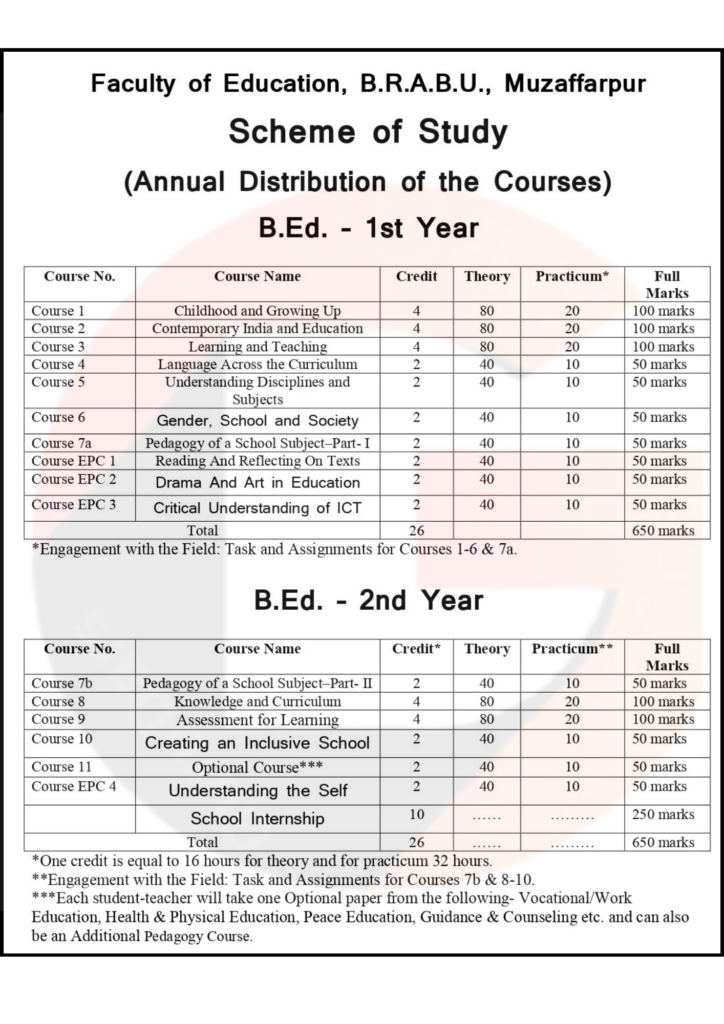
B.Ed.-1st Year
Course 1-Childhood and Growing Up
Unit 1: Understanding Childhood
• Understanding Childhood : Developmental Perspective
• Dimensions of Childhood : Social, Cultural, Political and Economic
• Key Factors during Childhood : Family, Neighborhood, Community and School
• Children and their Childhood: The Contextual Realities of Bihar
• General objectives of early childhood Education as related to national goals.
• Notion of joyful Childhood : Major discourse and educational implications
• Dimensions of individual development : physical, cognitive, language, social, and moral, their interrelationships and implications for teachers (with reference to Piaget, Erickson and Kohlberg)
Unit 2: Understanding Adolescence
Adolescence : assumptions, stereotypes and need of a holistic understanding
• Major issues: growth and maturation, nature and nurture, continuity and discontinuity
• Learner as an adolescent : stages of development- developmental task with focus on process of growth and development across various stages from infancy to adolescence
• Factors affecting adolescence : social, cultural, political and economic
• Adolescence: activities, aspirations, conflicts and challenges of learner
• The contextual reality of adolescence in Bihar
• Dealing with adolescence ; discourse on the role of teacher, family, community and state
Unit 3: Understanding Socialization and the Context of the Learner
Understanding Socialization
• Socialization at home context: family as a social institution; parenting styles and their impact; transmission of parental expectations and values
• Socialization and the context of community: neighborhood, extended family, religious group and their socialization functions
• Socialization and the context of school : impact of entry to school, school as a social institution and its notions in Bihar, value formation in the context of schooling
• Schooling as a process of identity formation: ascribed, acquired and evolving
• Gender Identities and Socialization Practices in family, schools, other formal and informal organization; Schooling of Girls
• Inequalities and resistances in society: issues of access, retention and exclusion
Unit 4: Understanding Differences in Learners
Difference in learners based on socio-cultural contexts : impact of home languages of learners’ and language of instruction, impact of differential ‘cultural capital’ of learners
• Differences between individual learners: multiple intelligence, learning style, self-concept, self-esteem, attitude, aptitude, skills and competencies, interest, values, locus of control and personality
• Understanding differently-abled learners: slow learners and dyslexic learners
• Methods of assessing individual differences: tests, observation, rating scales, self-reports
• Catering to individual differences: grouping, individualizing instruction, guidance and counseling, bridge courses, enrichment activities and clubs
Unit 5: Learner’s Identity Development
Understanding ‘Identity Formation’; emergence of multiple identities in the formation of a person placed in various social and institutional contexts; the need for inner coherence; managing ‘conflicting’ identities
• Determinants of identity formation in individual and groups; social categories such as caste, class, gender, religion, language and age
• School as a site of identity formation in teacher and students; school, culture and ethos, teaching-learning practices and teacher discourse in the classroom, evaluation practices; value system and ‘hidden curriculum’ in schools
• The influence of peer group , media, technology and globalization on identity formation
Course 2-CONTEMPORARY INDIA AND EDUCATION Course
UNIT- I- UNDERSTANDING OF THE CONCEPT & AIMS OF EDUCATION
Concept: Meaning and definitions of education, Processes of education- Schooling, Instruction, Training and Indoctrination. Modes of education- Formal, Informal and Non-Formal Aims: Meaning and functions of Aims, Classification of Aims of Education, Determinants of Aims of Education, Aims of education in relation to an individual, Aims of education in relation to a society / Nation, Philosophical contradictions between individualistic and socialistic aims and their synthesis
UNIT II: NORMATIVE VISION OF INDIAN EDUCATION
• Normative orientation of Indian education: A historical enquiry
• Constitutional provisions on education that reflect National ideals: Democracy, equality, liberty, secularism, and social justice
• India as an evolving Nation, State: Vision, Nature and Salient Features – Democratic and Secular polity, Federal structure: Implications for educational system
• Aims and purposes of education drawn from the normative vision
• Education for National development: Education Commission (1964- 66)
• Emerging trends in the interface between
(i) Political process and education; (ii) Economic developments and education; and (iii) Socio-cultural changes and education.
UNIT- III- PHILOSOPHICAL VISION OF EDUCATION AND THE PHILOSOPHICAL SYSTEMS
Philosophy and Education: Meaning and definitions of philosophy, Branches of philosophy and their relationship with educational problems and issues. Philosophical systems: Schools of philosophy- Idealism, Naturalism, Pragmatism, Marxism, and Humanism with special reference to their concepts of reality, knowledge and values, and their educational implications for aims, curriculum, methods of teaching and discipline.
UNIT IV: PHILOSOPHICAL VISION OF EDUCATION: EDUCATIONAL THINKERS
An overview of salient features of the ‘philosophy and practice’ of education advocated by the following thinkers: Indian Thinkers: R.N. Tagore, M.K. Gandhi, Swami Vivekananda, Aurobindo Ghose, Jiddu Krishnamurthi and Gijju Bhai Badheka Western Thinkers: Plato, Rousseau, Dewey, Froebel and Maria Montessori
UNIT V: CONTEMPORARY INDIAN SCHOOLING: CONCERNS AND ISSUES
• Universalization of School Education; Right to Education and Universal Access:
(i) Issues of a) Universal enrollment b) Universal retention c) Universal success (ii) Issues of quality and equity. The above to be discussed with specific reference to physical, economic, social and cultural access, particularly to girl child and weaker sections as well as differently- abled children
• Equality of Educational Opportunity:
(i) Meaning of equality and constitutional provisions (ii) Prevailing nature and forms of inequality, including dominant and minor groups and related issues (iii) Inequality in schooling: Public-private schools, rural-urban schools, single teachers’ schools and many other forms of inequalities in school systems and the processes leading to disparities (iv) Differential quality in schooling: Variations in school quality
• Idea of ‘common school’ system
• Right to Education Bill and its provisions.
Course 3-LEARNING AND TEACHING
Unit I: Learning: Its Nature, Types and Strategies
Concept & Nature of Learning, Concept learning, skill learning, verbal learning, social learning, principle learning, problem solving
• Basic Assumptions and analysis of the relevance of Learning Theories – Behavioral, Social, Cognitive & Humanistic learning theories;
• Learning as a process of construction of knowledge – Constructivist Approach to learning
16 | P a g e
• Relationship of learning with school performance and ability of the learner
Unit II: Factors affecting Learning & Management of Learning
• Concept of Motivation; types, techniques of enhancing motivation,
• Health, sleep, difficulty of task, content and study habits as factors Influencing learning
• Influence of method of learning: part and whole learning; superficial and in-depth learning; Influence of prior learning on present learning; Strategies for transfer of learning
• Forgetting classroom learning – meaning and its causes; strategies for improving retention of learning
• Meaning of learning to learn skills; Ways of developing self- study
Unit III: Understanding Teacher and Teaching
• What is teaching?; Teaching as a planned activity – elements of planning.
• Assumptions underlying teaching and their influence on the planning for teaching. Proficiency in Teaching: Meaning and place of awareness, skills, competencies and commitment.
• Assumptions underlying effectiveness in teaching – Behaviouristic, Humanistic and Constructivist perspectives.
• An analysis of teacher’s roles and functions, skills and competencies in the Pre-active phase – visualizing, decision-making on outcomes, preparing and organization; Interactive phase – facilitating and managing learning; Post-active phase – assessment of learning outcomes, reflecting on pre-active, interactive and post-active processes
• Characteristics associated with effective teachers; Teacher’s professional identity – what does it entail?
Unit IV: Planning for Teaching
• Visualizing: The learner and learning readiness characteristics, the subject matter content and their inter-linkages, the learning resources, approaches/ strategies.
• Decision-making on outcomes: Establishing general instructional goals, specification of objectives and standards for learning, allocation of instructional time for various activities/ tasks – instructional time as a variable in learning.
• Decision-making on instructional approaches and strategies: Expository or Inquiry, Individualized or Small Group or Whole Class – skills required for learner engagement in the context of the strategy decided.
• Preparing for instruction: Identifying and selecting available learning resources or developing required learning resource.
• Preparation of a Plan: Unit Plan and Lesson Plan.
Unit V: Skills and Strategies of Teaching
• Introducing a lesson – need and various possibilities
• Motivating the learners and sustaining their attention – importance of stimulus variation and reinforcement as skills.
• Questioning, Illustration and explanation as teacher competencies influencing student-learning in the classroom;
• Strategy of Teaching – a) Expository Strategy as approach to teaching for understanding: Presentation – discussion – demonstration, the Advance Organizer Model; b) Inquiry Strategy as approach to teaching thinking skills and construction of knowledge : Concept attainment / Concept formation, Inductive thinking, Problem based learning/ Project Based Learning.
• Approaches to Individualized Instruction: Computer Managed Instruction, Programmed Instruction and Learning Activity Packages,
• Approaches to Small Group and Whole group Instruction: Cooperative and Collaborative approaches to learning, Brain storming, Role Play and Dramatization, Group Discussion, Simulation and Games, Debate, Quiz and seminar.
Course 4-LANGUAGE ACROSS THE CURRICULUM
Unit 1: Learner and their Language
• Meaning of Language; various forms, systems and properties
• Language capital of learners before school entry
• How children learn language with special reference to Skinner, Chomsky, Piaget and Vygotsky.
• Difference between acquiring language and learning language
• Social and cultural context of language; Language and Gender; Language and Identity; Language and Power; Language and Class (Society).
21 | P a g e
• Political context of language; Multilingual perspective of India and Bihar, Constitutional provisions related to languages in India
Unit 2. Language in School Curriculum:
Home language and School language; Medium of understanding (child’s own language);
• Centrality of language in learning;
• Language across the curriculum; Role and importance of language in the curriculum
• Language and construction of knowledge; Understanding the objectives of learning languages: imagination, creativity, sensitivity, skill development
• Difference between language as a school- subject and language as a means of learning and Communication;
• Critical review of Medium of Instruction; Different school subjects as registers;
• Multilingual classrooms; Multicultural awareness and language teaching.
Unit 3. Constitutional Provisions and Policies Of Language Education:
Position of Languages in India; Articles 343-351, 350A;
• Recommendation of Kothari Commission (1964-66); NPE-1986; POA-1992;
• National Curriculum Framework-2005 (language education).
Course 5-UNDERSTANDING DISCIPLINES AND SUBJECTS
Unit I: Basic Understanding of disciplines and Subjects
• What is a discipline?; History of the concept of discipline.
• What Are Academic Disciplines?Need/ Perspectives of the classification of Human knowledge into disciplines & Subjects; 1. The Philosophical Perspective: Unity and Plurality, 2. The Anthropological Perspective: Culture and Tribes, 3. The Sociological Perspective: Professionalization and Division of Labour 4. The Historical Perspective: Evolution and Discontinuity, 5. The Management Perspective: Market and Organization, 6. The Educational Perspective: Teaching and Learning
• Difference between discipline and subject; Nature and scope of disciplines/subjects
• Strengths and weaknesses of disciplines
• Basic premises and philosophy of subject
• Aims of disciplines/subjects for learners development in the national context
Unit II: Competencies for and Advancement of the disciplines/subjects
•Mastery over the subject
• Communicating the subject
• Subject specific terms and their uses
• Projects/activities in the subject
• Research in subject/discipline; Methods of data collection in the subject, Drawing conclusion, generalization and theory development, Preparing reference, notes and bibliography
Unit III: Interdisciplinary learning and the related issues
•What is Interdisciplinary learning? Interdisciplinary learning – a dialectical process,
•What are interdisciplinary subjects?
•What are the generic objectives of interdisciplinary subjects?
• Do interdisciplinary subjects require disciplinary depth?
• How can you design and coordinate interdisciplinary subjects?
• How can you assess interdisciplinary learning?
•What criteria can be used for quality assurance of interdisciplinary subjects?
Course 6-GENDER, SCHOOL AND SOCIETY
UNIT I: GENDER ISSUES: KEY CONCEPTS
Gender, sex, sexuality, patriarchy, masculinity and feminism
• Gender bias, gender stereotyping, and empowerment
• Equity and equality in relation with caste, class, religion, ethnicity, disability and region
• Paradigm shift from women’s studies to gender studies
• Historical backdrop: Some landmarks from social reform movements of the nineteenth and twentieth centuries with focus on women’s experiences of education
• Contemporary period: Recommendations of policy initiatives commissions and committees, schemes, programmes and plans.